
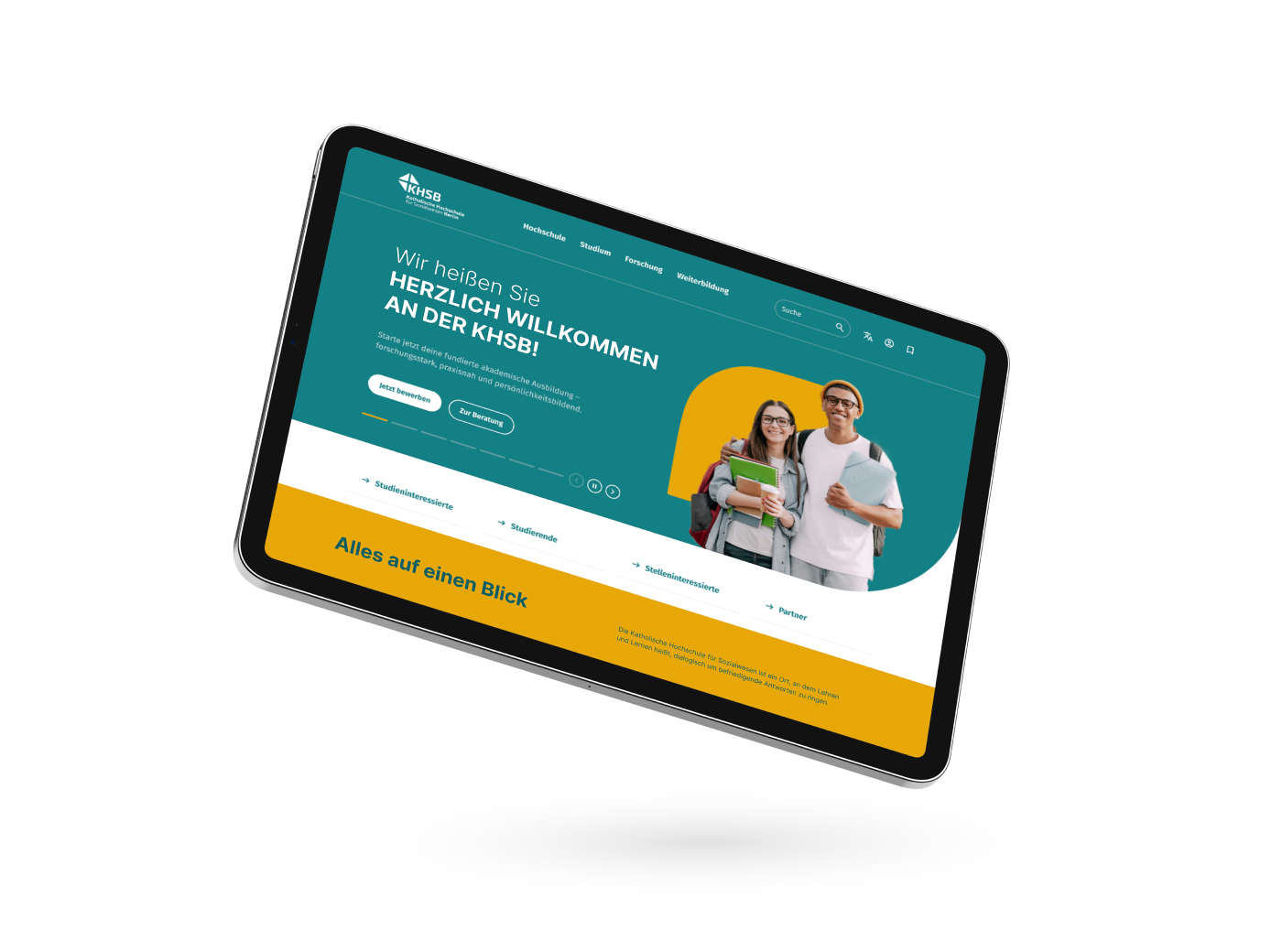

Catholic University of Applied Sciences for Social Work, Berlin (KHSB)

KHSB website relaunch

Relaunch of the website of the Catholic University of Applied Social Sciences Berlin using TYPO3. The focus was on a user-centred information architecture, accessible design, efficient editorial workflows and sprint-based collaboration with clear quality assurance.

Catholic University of Applied Sciences for Social Work, Berlin (KHSB)
CMSTYPO3
Way of workingAgile, sprint-based with PO coordination
Focus areasInformation architecture, templates, editorial work, QA, launch

The challenge

What the university came to us with.

The existing website needed to be revamped in terms of its structure, design and technical infrastructure. At the same time, it was necessary to migrate a large volume of content accurately, ensure that key page types were presented consistently, and organise collaboration with multiple stakeholders reliably within an agile framework. In the higher education sector, this involves a mix of different target groups, numerous stakeholders and diverse content.

Catholic University of Applied Sciences for Social Work, Berlin (KHSB)
01

Diverse content and target audiences

In the university environment, there is a mix of different target groups, numerous stakeholders and a wide variety of content. The website had to be structured in such a way that content remains easy to find.

02

Inconsistent page types

Key page types were not presented in a consistent manner. What was needed was a clear, recognisable structure across all content areas.

03

Extensive editorial maintenance

Content could not be managed efficiently. Editorial teams and media management required reliable modules and workflows.

04

Smooth migration and maintainability

A great deal of content had to be migrated accurately. At the same time, the aim was to create a technical infrastructure that could be maintained in the long term.

05

Stable cooperation alongside ongoing adjustments

Coordination with multiple stakeholders and ongoing adjustments, such as bug fixes and change requests, had to be organised reliably, even during ongoing operations.

The approach

How we solved it.

We developed the website iteratively in sprints, with regular reviews, coordination with the product owner and end-to-end quality assurance from the design phase right through to launch.

01

Discovery and structural work

To begin with, we analysed the content, navigation and page types, and developed a structural and page-type framework for key content and overviews. This resulted in a clear user journey and navigation logic.

02

Design system and templates

We have developed consistent templates and content modules and implemented reusable components for content and overview pages. Map and teaser layouts have been optimised for the various page types, such as profiles and content teasers.

03

TYPO3 Content Management and Workflows

To ensure efficient maintenance, we have improved input forms and modules, including self-service components. Media handling has been implemented, including alt text and copyright workflows.

04

Iterative implementation in sprints

Implementation was carried out using a sprint-based approach, with regular reviews and coordination meetings, including a regular Product Owner meeting. This allowed requirements and change requests to be integrated into the modular system seamlessly.

05

Quality assurance

We have established a transparent QA and acceptance process via staging. This has ensured that quality has remained consistent even whilst adjustments are being made.

06

Go-live and operation

We oversaw the go-live planning as well as domain and launch-related matters, and organised the transition to production. Reliable release and handover processes were established to support further development.

The result

What has measurably changed.

The relaunch creates a consistent, maintainable TYPO3 platform that helps users find what they’re looking for more quickly and makes day-to-day editorial work noticeably easier.

More references

More proof.

Initial consultation — 30 minutes, no pitch deck.

Planning something similar?